
The case was published on September 12, 2026. The images are for illustrative purposes; the screenshots show the product with example data, not actual client results. The prices cited correspond to the original publication and require confirmation.
Editorial review: September 20, 2026DITAP Vivero has replaced traditional nursery notebooks with a mobile point-of-sale system – a solution used via a smartphone at the reception desk. This system now tracks every sale, every stock movement, and the daily cash register data within a single system. It’s currently in production, with a pilot client using the system daily; this is not a prototype or a commercial demo.
Before DITAP Nursery, managing a real nursery involved only a notebook, a calculator, and the memory of the person on duty. It worked, until it stopped working: someone would sell the last unit of something that, according to the notebook, “still had some left,” or no one could remember how much it cost to replace a plant three weeks ago.
From the notebook to the table.
The nursery being used today by DITAP Vivero is a genuine business, managed by its owner, who is not a technical expert. This detail is more significant than it initially appears: the system wasn't designed for a systems administrator; it was created for someone who needs to process transactions quickly, with a customer waiting, and to know at the end of the day how much came in and how much stock remains.
| Before | After |
|---|---|
| Notebooks and a calculator for earning/collecting. | Available for purchase at the tavern, and also by phone. |
| The market was known as “uncertain” or “unclear.” | Every stock movement is recorded, and it’s not manually edited. |
| Manual record for items that weren't sales. | Okay, here's the translation: “Delivery slips, detached from the receipt, for trips without charge.” |
| Identifying a plant depended on asking someone. | Plant identification by photo, with suggested scientific name. |
What was built.
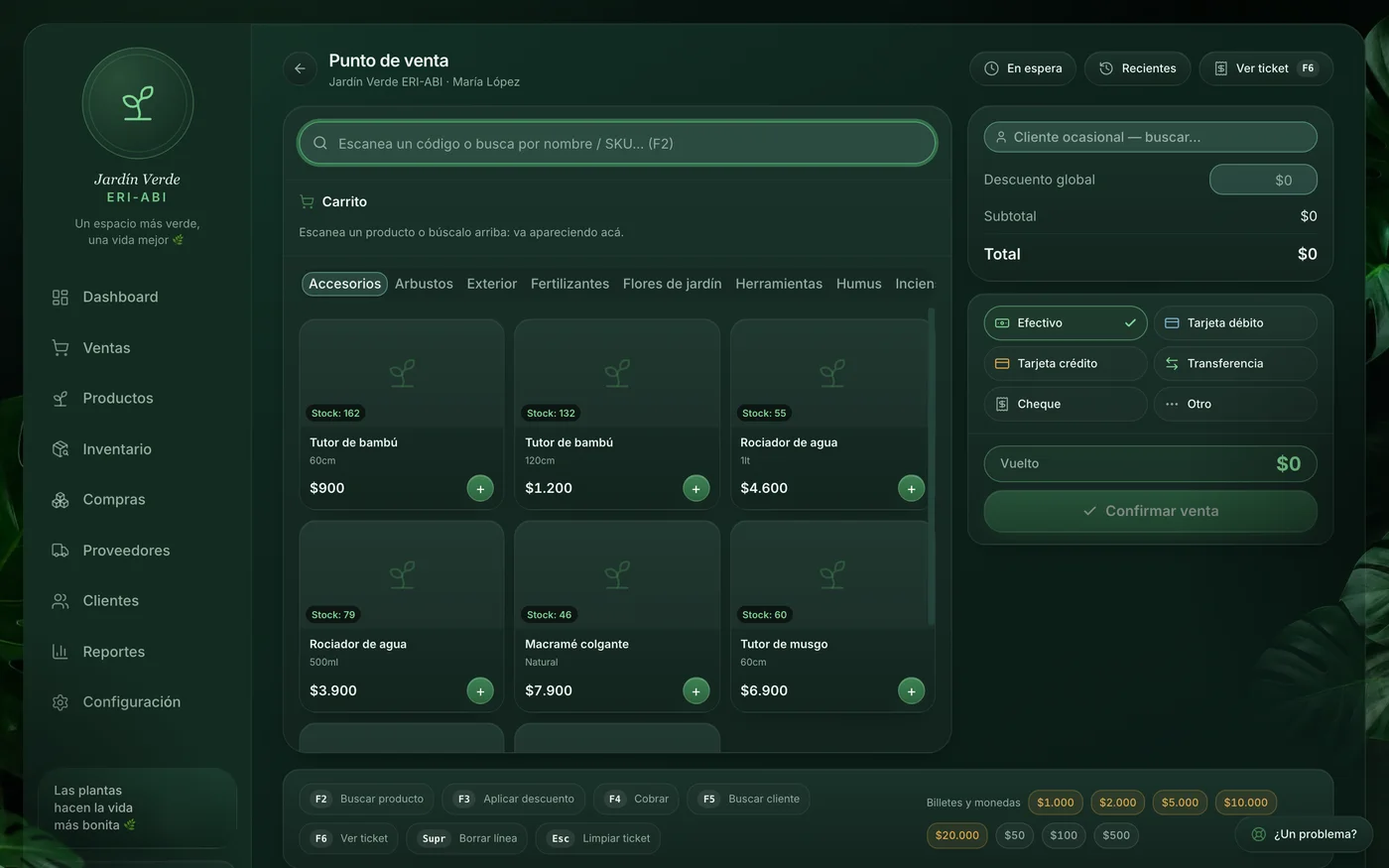
The system covers everything a business with a traditional restaurant needs on a daily basis – it’s not a list of features that no one actually uses.
- Quick sale.Designed to be used when waiting for a client to arrive, not for filling out forms.
- Stock movements with traceabilityEach entry and exit is recorded by the system, never written down manually on the previous number.
- Okay, for delivery.Aside from the receipt, any item that leaves the store without being a sale (like a restock or a warranty replacement).
- Plant identification by photo... with a scientific name, so that those providing care don’t have to memorize every species in the catalog.
- Permissions based on roleSo that each person on the team can see and only do what is assigned to them.
How it was initiated
The change didn’t happen overnight and didn’t require closing the store. Initially, the product catalog and starting inventory, along with the nursery staff, were uploaded into the system. For the first few days, the team began selling with the system, still using a notebook as a backup in case of any issues. However, after a few weeks, the notebook was no longer needed – the system responded much faster than manually recording everything, and unlike the notebook, no one had to do any calculations at the end of the day.
That process – starting with the catalog, followed by support, and using a notebook as a backup until it’s no longer needed – is the same one DITAP Vivero uses with any new business venture, not a special procedure created solely for the pilot program.
Why does it matter that it’s real?
The case published in September 2026 describes a launch with a pilot client who opens, processes, and closes the day using the system. The screenshots accompanying this edition show the product interface with example data; they are not evidence of sales, margins, or results from that client.
That is also the reason why. DITAP Nursery It’s offered as a service within Ditap Negocios: it’s not a product created out of nowhere and then marketed to clients. Instead, it’s a system developed in response to a genuine problem faced by a real client, and then offered to other businesses experiencing the same issue.
For whom does it serve best?
The problem that DITAP Vivero (a nursery – encompassing a small restaurant/dining area, physical inventory, and a squaring-off process if not recorded at the time) is facing isn't unique to nurseries. It occurs in:
- Hardware stores with a shop/counter and a wine cellar.
- Small distribution companies that fulfill and sell directly to retail stores.
- Workshops with parts that are currently managed using spreadsheets or memory.
What follows
The system is live and costs $49,000 per month per location. There’s a premium plan for $99,000 for businesses that require more reports or more users. There’s no separate installation or long learning curve – simply upload the catalog, load the initial stock with the team, and start selling from day one. If your business resembles a nursery more than an office… Diagnosis of processes It’s a good initial step to confirm whether the system works as is, or if some adjustments need to be made beforehand.
Frequently Asked Questions
Is it a real system or a demo?
Real is in development, with a pilot client who uses it daily to sell, manage, and control their inventory – not just a prototype for a presentation.
Does it work for other fields besides nurseries?
Yes. It was designed for a nursery, but the problem it solves – (a mesón, physical stock, daily cash) – is the same in a hardware store, a small distributor, or a workshop.
How much does it cost?
$49,000 per month per location, with a premium plan for $99,000 offering additional reports and users.
What if I give something away without being paid for it, like a replacement plant?
There is a separate delivery voucher, detached from the receipt, for deliveries that are not sales – it is recorded separately, without being mixed in with the daily cash.

Founder of DITAP
Knowing business.